4Q 2025 Rental Report: Private and HDB Segments See Marginal Pullback in Rents and Leasing Activity Amid Holiday Season
- Source
- Stanley Lim
- Published
- 30 Jan 2026
- Category
- Research

Private Residential Rental Market
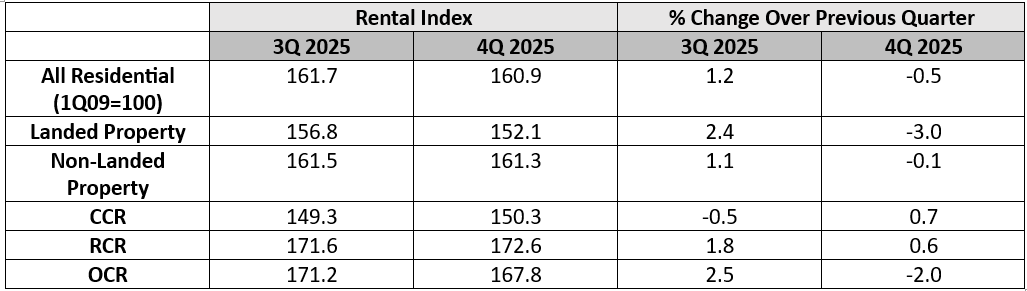
In 4Q 2025, Singapore’s residential rental market saw a slight pullback in both rents and leasing activity on the quarter. The rental index for private residential properties edged down 0.5% quarter-on-quarter (q-o-q) to 160.9, reversing the 1.2% q-o-q gain recorded in the previous period. However, this still translates into a 1.9% year-on-year (y-o-y) increase, effectively off-setting the full-year decline seen in 2024.
Table 1: Comparison of Private Property Rental Index for 3Q 2025 and 4Q 2025
Residential leasing activity also softened over the quarter. According to URA data as at 30 January 2026, rental volume across landed homes, non-landed private properties and executive condominiums totalled 20,604 contracts in 4Q 2025.
Chart 1: Rental Contracts Across Landed, Non-Landed Properties and Executive Condominiums (Year and Quarter)
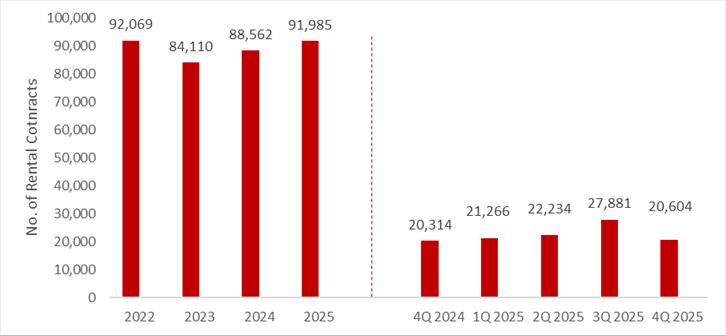
On a quarterly basis, this marks an 26.1% decline in leasing activity, partly reflecting the year-end holiday season when leasing demand tends to soften as foreign tenants travel overseas. However, annual rental volume still posted a modest 3.9% y-o-y increase, rising from 88,562 contracts in 2024 to 91,985 contracts in 2025.
Chart 2: Rental Index of Non-Landed Private Properties (By Region) and Landed Properties
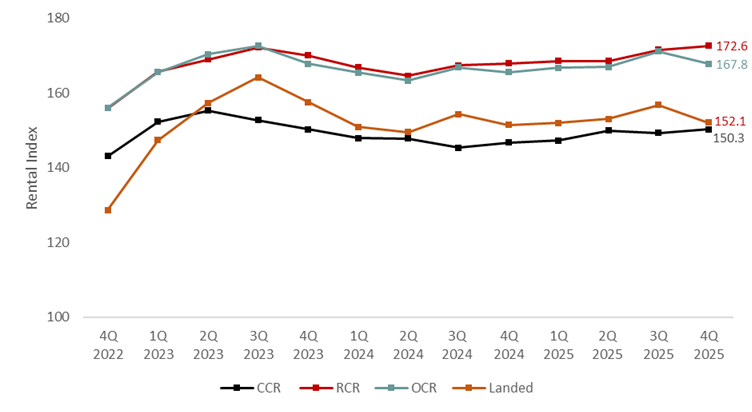
Within the non-landed private property segment, the Core Central Region (CCR) saw the biggest uptick in rents in 4Q 2025, recording a 0.7% q-o-q increase to a rental index of 150.3. This is followed by the Rest of Central Region (RCR), where a similar quarterly growth of 0.6% was recorded. In contrast, the Outside Central Region (OCR) saw non-landed private property rents dipping 2.0% q-o-q.
Table 2: Comparison of Non-Landed and Landed Private Property Rental Index by Year (2021 to 2025)
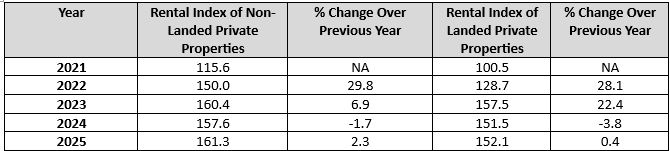
Collectively, these shifts resulted in a 2.3% y-o-y increase in overall rents for non-landed private properties, with the rental index rising from 157.6 in 2024 to 161.3 in 2025. This not only reversed the 1.7% y-o-y decline recorded in 2024, but also marked a return to positive annual rent growth.
Chart 3: Private Residential and EC Completions and Expected Pipeline Supply
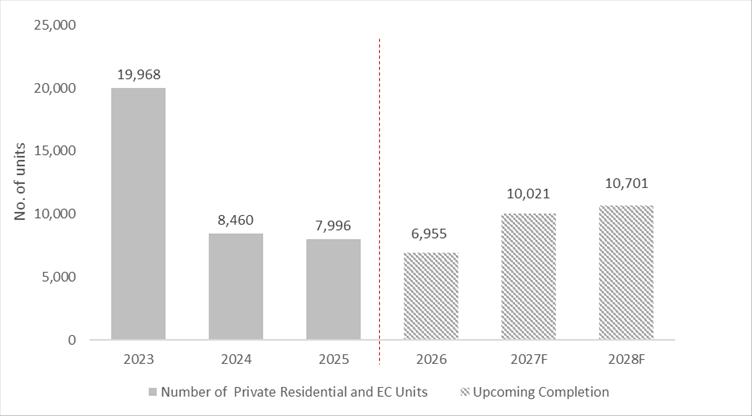
This overall uptick in non-landed private property rents coincides with a smaller number of completions in the private housing segment. In 2025, a total of 6,123 private residential units (excluding ECs) were completed, representing a significant 27.6% y-o-y decline from 8,460 units in 2024. This had likely lent support to rent growth over 2025.
Table 3: Projects Completed in 4Q 2025

4Q 2025 saw the completion of AMO Residence in the OCR and Tembusu Grand in the RCR. Together, these developments added about 1,010 completed units to the market, which could expand the availability of rental options within their respective neighbourhoods.
Table 4: Top 10 Non-Landed Private Projects Ranked by Rental Contracts
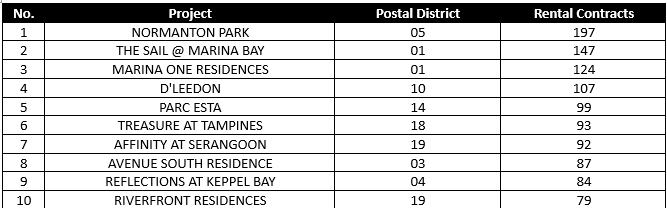
Based on URA data as at 30 Jan 2026, non-landed private residential projects (excluding ECs) that saw the most rental contracts signed in 4Q 2025 include Normanton Park, The Sail @ Marina Bay and Marina One Residences.
Table 5: Vacancy Rate of Private Residential Properties by Quarter and Market Segment
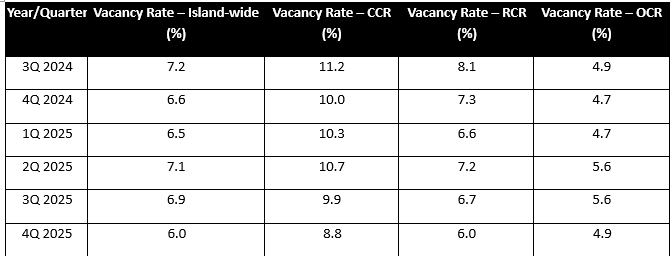
In tandem with the pickup in rental contracts and firmer support for rent growth in 2025, island-wide vacancy rates also declined on an annual basis.
In 2024, the overall vacancy rate stood at 6.6%, and this has since fallen to 6.0% in 2025, marking a return to the same level last seen in 2021. Overall, this likely reflects a stabilising market for the private home segment, with new supply from completions in the earlier half of 2025 being readily absorbed by renters.
HDB Rental Market
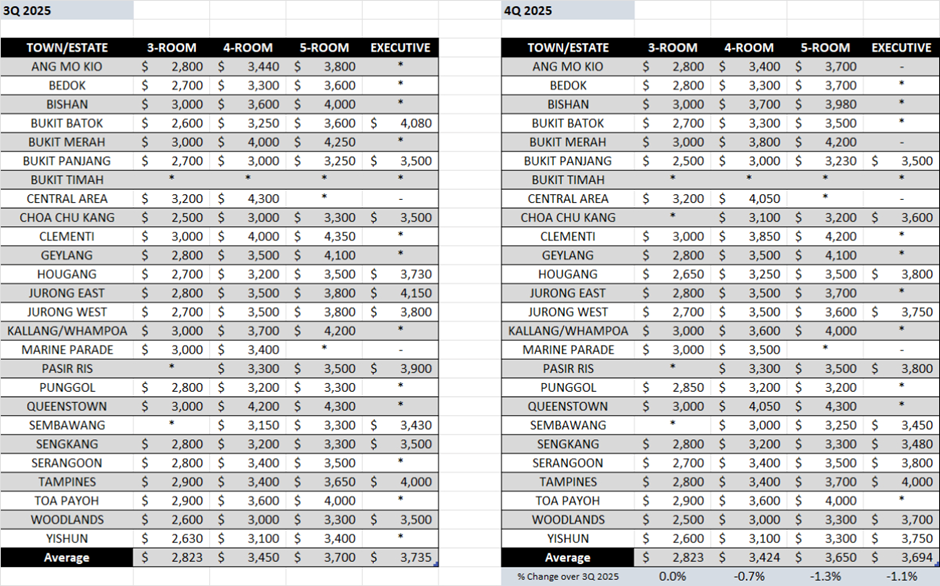
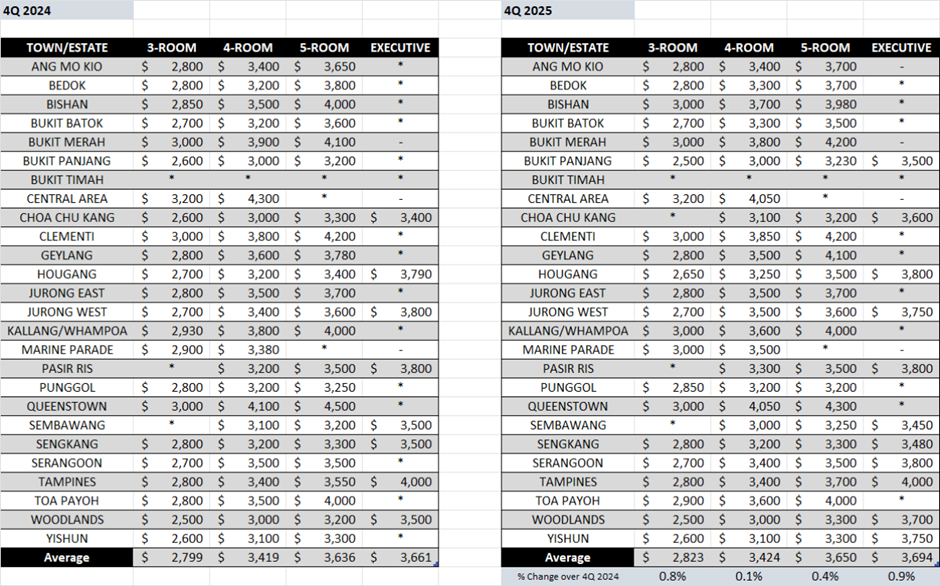
Median rents for HDB flats softened across most room types in 4Q 2025. On a quarterly basis, median rents for 4-room, 5-room and Executive flats edged down by 0.7%, 1.3% and 1.1% q-o-q respectively, while those for 3-room flats were unchanged.
However, on a yearly basis, rents remained marginally higher. Median rents for 3-room, 4-room, 5-room and Executive flats rose by 0.8%, 0.1%, 0.4% and 0.9% y-o-y respectively.
Table 6: 3Q/4Q 2025 HDB median rents by town and q-o-q growth
(-) Indicates that there are no rental transactions in the quarter
* Indicates that the median rent is not shown because there are less than 20 rental transactions in the quarter for that particular town and flat type
Table 6: 3Q/4Q 2025 HDB median rents by town and y-o-y growth
(-) Indicates that there are no rental transactions in the quarter
* Indicates that the median rent is not shown because there are less than 20 rental transactions in the quarter for that particular town and flat type
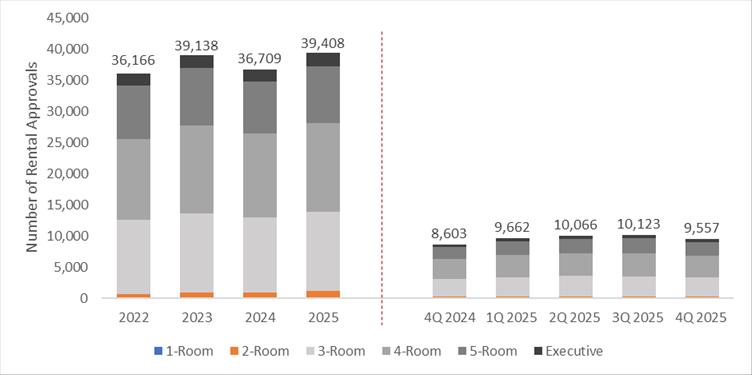
The number of approved HDB rental applications reflected similar quarterly and annual trends. In 4Q 2025, a total of 9,557 rental approvals were recorded, marking a 5.6% decline from 3Q 2025. However, on a full-year basis, rental approvals rose by 7.4% y-o-y, growing from 36,709 cases in 2024 to 39,408 cases in 2025.
Chart 4: Number of rental approvals for HDBs
Resilience expected for Singapore’s rental market in 2026, buoyed by continued demand from locals and foreigners
In 2025, Singapore’s residential rental market remained supported by both local and foreign demand, including interim leasing by homeowners awaiting their new homes, as well as continued interest from foreign professionals. This demand also stemmed from a modest pool of private property right-sizers under the age of 55, who are subject to a 15-month wait-out period before becoming eligible to purchase an HDB flat.
Separately, advance estimates from the Ministry of Manpower showed that Singapore’s labour market continued to expand in 4Q 2025 and for the full year of 2025. Total employment growth was also stronger than in 2024, with unemployment and retrenchments remaining slow and stable. These factors could continue to provide a steady backdrop for housing demand in Singapore, including the rental segment, although expectations of a tighter hiring market in early 2026 and potential trade tensions may temper renter sentiment.
Within housing segments, the HDB rental market could see a notable supply injection as more flats exit their Minimum Occupation Period (MOP), with numbers rising from 6,973 units in 2025 to 13,480 units in 2026. This uptick in available rental stock could translate into greater competition among landlords, placing some pressure on rent growth.
Based on these prevailing conditions, ERA estimates that rents for private homes (excluding ECs) could grow between 1% to 3% y-o-y in 2026, with corresponding annual rental contracts reaching around 88,000 to 93,000 cases.
For the HDB segment, median rents are projected to rise by 2% to 6% y-o-y in 2026, with rental approvals potentially reaching 34,000 to 36,000 cases over the same period.