2Q 2026 Industrial Property Market: Industrial Market Holds Steady Amid Cautious Sentiment
- Source
- ERA Singapore
- Published
- 20 Aug 2026
- Category
- Research

Economic Overview
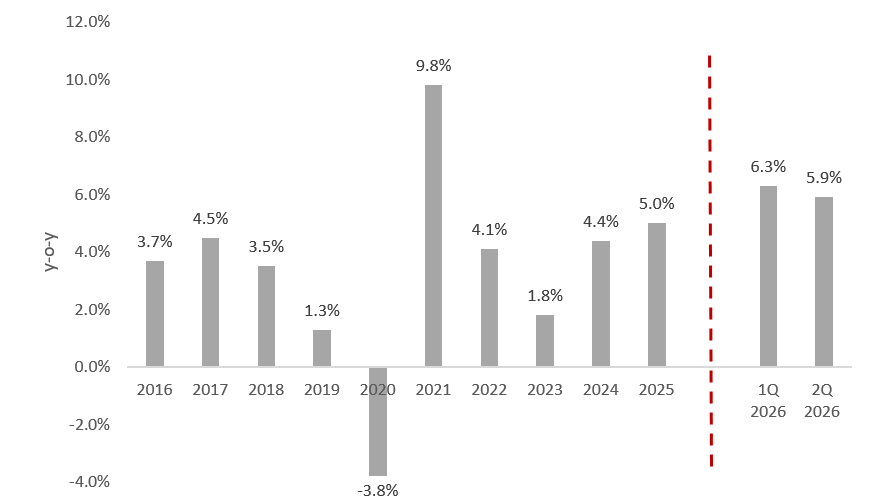
Singapore’s economy grew by 5.9% year-on-year (y-o-y) in 2Q 2026, a slight slowdown from the 6.3% recorded in the previous quarter. The expansion was supported by robust performance in the electronics and precision engineering sectors, fuelled by AI-related demand.
In August, the Ministry of Trade and Industry (MTI) raised Singapore’s 2026 GDP growth forecast to a range of 4.5% to 5.5%, an increase from the previous estimate of 2.0% to 4.0%. This adjustment reflects stronger-than-anticipated growth in the first half of the year and a more optimistic outlook for the latter half.
Chart 1: Singapore GDP y-o-y growth rate
From April to June 2026, the Purchasing Managers' Index (PMI) ranged from 50.7 to 51.3. This represents an increase from the first quarter's 50.5 and 50.6, indicating that the manufacturing sector continued to align with a slightly more optimistic growth outlook despite persistent geopolitical uncertainty.
Chart 2: Purchasing Manager Index
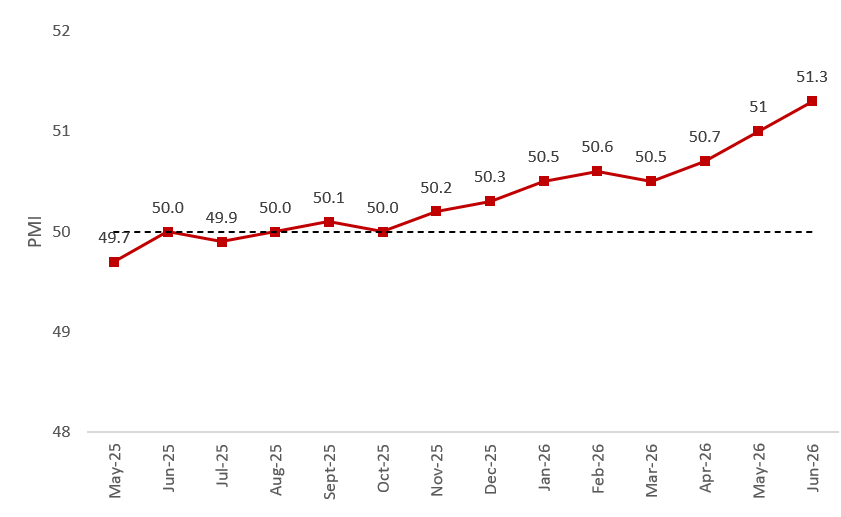
* A PMI score above 50 suggests that the manufacturing sector is expanding, while a score below 50 indicates decline. A score of exactly 50 means there is no change compared to the previous month.
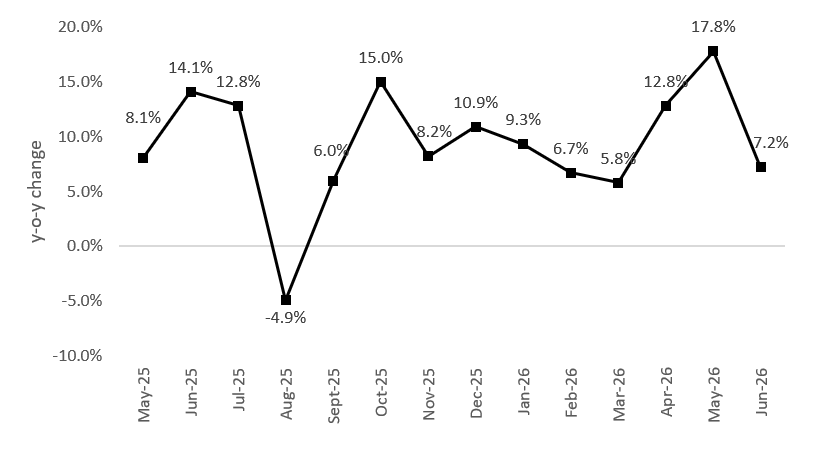
Other important manufacturing indicators, such as Non-Oil Domestic Exports (NODX) and industrial production, have largely remained stable, although the growth rate slowed toward the end of 2Q 2026. NODX remained above recent averages, buoyed by strong electronics exports and steady AI-related demand. Industrial production exhibited a similar trend. While electronics and precision engineering continued to support growth, overall expansion decelerated, with biomedical manufacturing output declining.
Chart 3: Non-Oil Domestic Exports and Manufacturing Exports
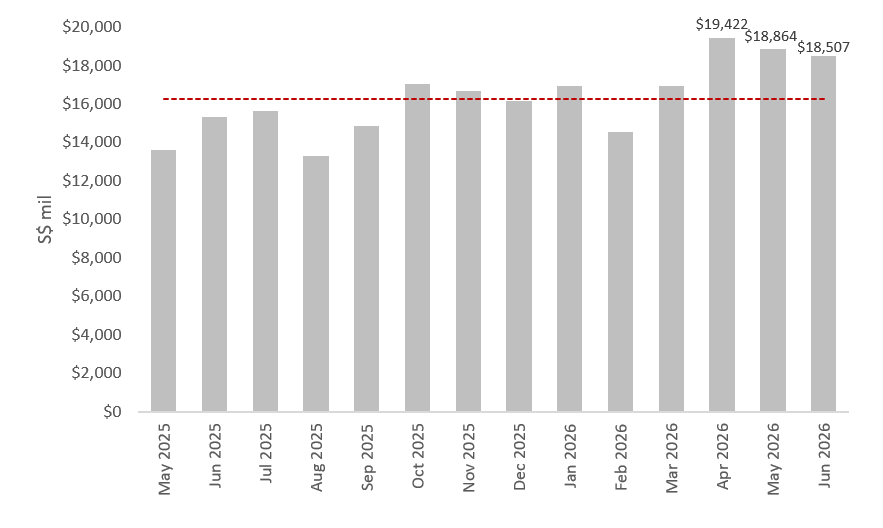
Chart 4: Index of Industrial Production y-o-y Change
Price and Transaction Volume
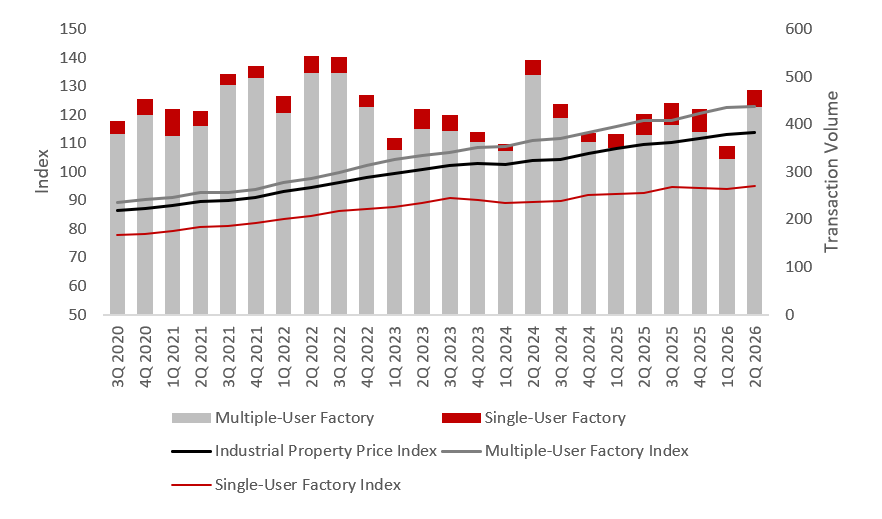
In 2Q 2026, the Industrial Property Price Index rose by 0.6% quarter-over-quarter (q-o-q), a slower pace than the 1.2% increase in 1Q 2026. This marks the eighth consecutive quarter of price increases, reaching an all-time high.
Transaction volume for multi-user factories rebounded by 33.6% q-o-q, reversing the 14.8% decline from the prior quarter. Similarly, single-user factory transactions surged by 25.0% q-o-q to 35 transactions, following a 40.4% drop in 1Q 2026.
Growth was mainly driven by single-user factories, which rose 1.1% q-o-q, while the multi-user factory index rose 0.4%. In the previous quarter, multi-user factories rose 1.7%, while single-user factories fell slightly by 0.1%.
Chart 5: Price Index and Transaction Volume
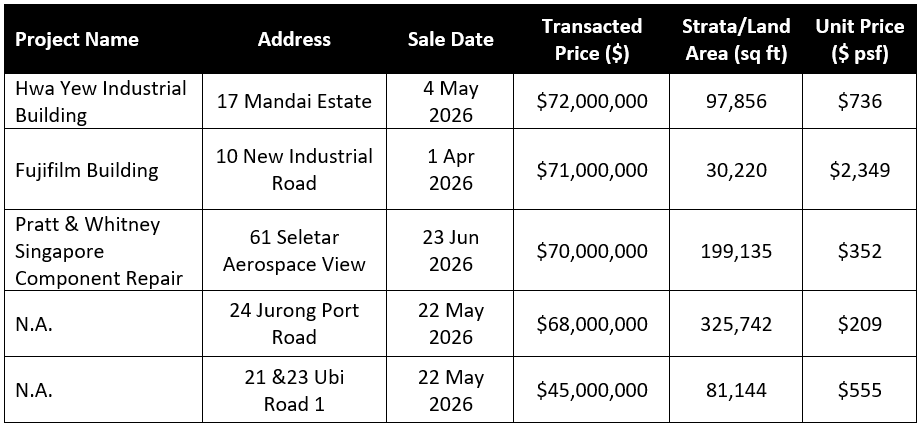
In 2Q 2026, key industrial transactions included the $72.0 million sale of Hwa Yew Industrial Building at 17 Mandai Estate, as well as the $71.0 million sale of Fujifilm Building at 10 New Industrial Road.
Other significant transactions included Pratt & Whitney Singapore Component Repair at 61 Seletar Aerospace View, sold for $70.0 million. Additionally, a warehouse at 24 Jurong Port Road and a single-user factory at 21 & 23 Ubi Road 1 were sold for $68.0 million and $45.0 million, respectively.
These large transactions reflect ongoing investor interest in industrial properties, especially well-located warehouses and specialized industrial facilities.
Table 1: Top Five Sales Transactions in 2Q 2026, based on caveats lodged
In June, 86 units of Gate+ were sold in the new-sale market, averaging $618 psf. Gate+ is a 33-year leasehold multi-occupancy factory located along Tukang Innovation Drive. Its appeal likely stems from its proximity to the upcoming Tukang MRT Station on the Jurong Region Line and easy access to the Ayer Rajah Expressway (AYE). Situated within the western industrial corridor, it offers convenient connectivity to major economic hubs like Jurong Lake District, Jurong Innovation District, and Tuas Mega Port.
In the same month, a tender for an industrial site along Jalan Buroh closed with three bids. The 33-year leasehold property is designated for a multi-tenant industrial development. In July, JTC awarded the site to Soilbuild Group, which offered the highest bid of $214.4 million, equivalent to $2,754 psm ppr.
Table 2: IGLS sites awarded in 2Q 2026

Rental Index
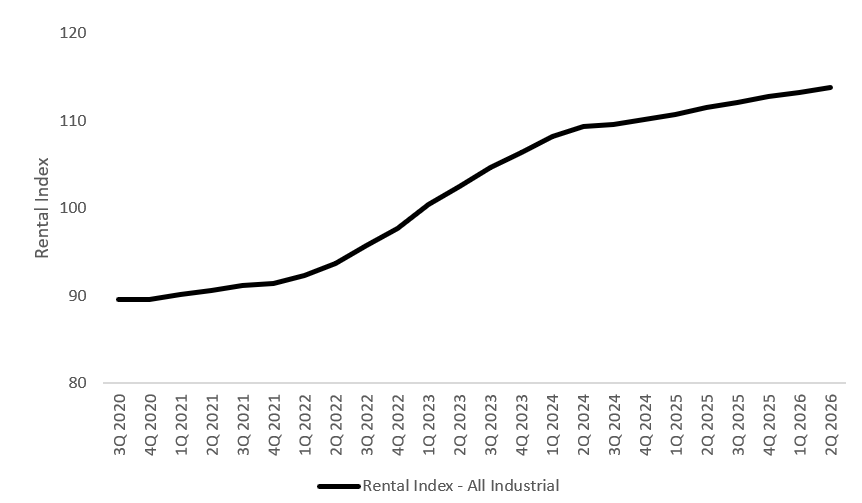
The All-Industrial Rental Index kept climbing, marking its 23rd straight quarter increase in 2Q 2026. Rents grew by an additional 0.5% quarter-over-quarter, up from 0.4% in 1Q 2026, indicating steady but moderate rental growth.
Chart 6: Rental Index for All industrial properties
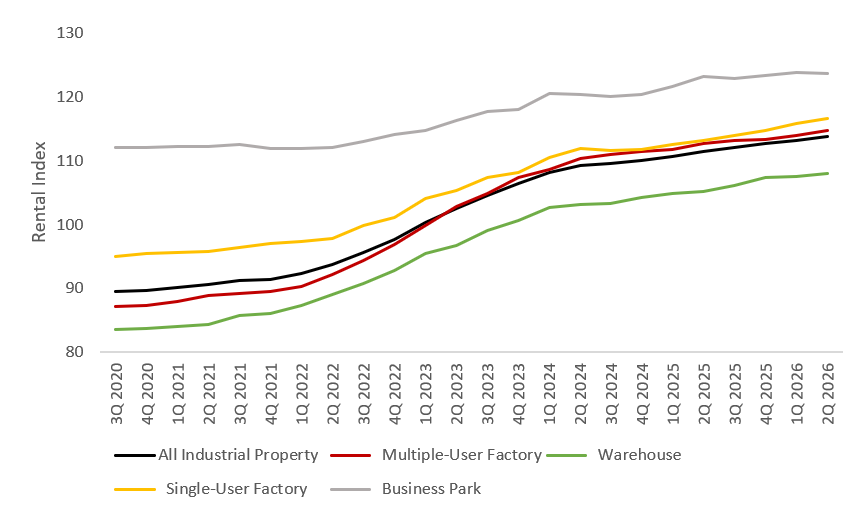
Single-user factory rents continued to post the fastest growth this quarter, up 0.7% q-o-q, albeit slower than the 1.0% increase in 1Q 2026.
Multiple-user factory rents increased by 0.6% quarter-over-quarter, while warehouse rents grew by 0.5%. Both types of industrial properties experienced stronger growth this quarter compared to the previous one, when rents for multiple-user factories and warehouses rose by 0.5% and 0.2%, respectively. Conversely, business park rents slightly declined by 0.1% quarter-over-quarter in the second quarter of 2026, reversing the 0.3% increase recorded in the first quarter.
Industrial property rental growth is projected to stay mostly positive, but tenants might become more cautious and selective due to increasing operational and energy expenses.
Chart 7: Rental Index by Property Type
Occupancy Rates
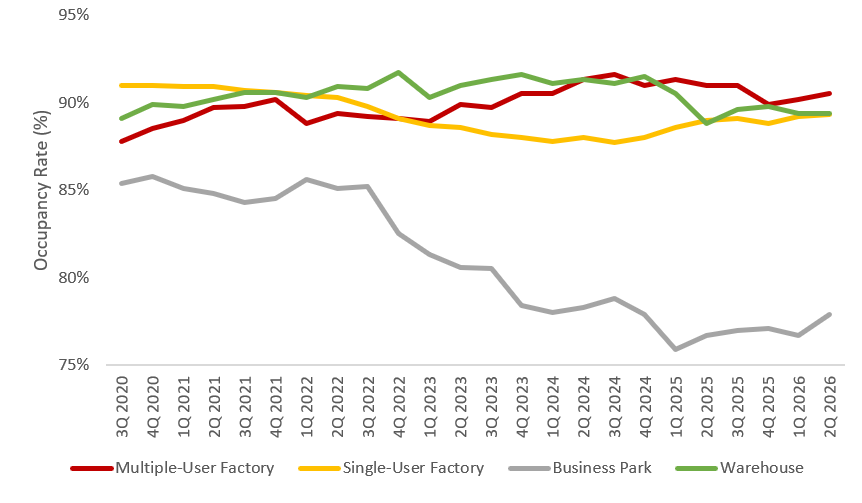
The industrial properties' occupancy rate stayed steady in 2Q 2026, increasing slightly from 88.9% to 89.1%, indicating that demand from occupiers remains strong.
Among the segments, business park occupancy saw the largest increase of 1.2 percentage points (ppts), reaching 77.9%, after a 0.4-ppt decrease in the previous quarter. The occupancy rate for multiple-user factories grew by 0.3 ppts to 90.5%, and single-user factories improved by 0.1 ppts to 89.3%. In contrast, the warehouse occupancy rate stayed steady at 89.4%.
Overall occupancy stability indicates that demand for industrial space stayed relatively steady in Q2 2026. This likely correlates with faster growth in manufacturing during the same period. MTI reports the manufacturing sector grew by 12.5% year-over-year in Q2 2026, up from 7.3% in the previous quarter. The positive economic outlook and increased AI-related investments are expected to bolster the industrial sector further in the second half of the year.
Chart 8: Industrial Properties Occupancy Rates
Upcoming Supply
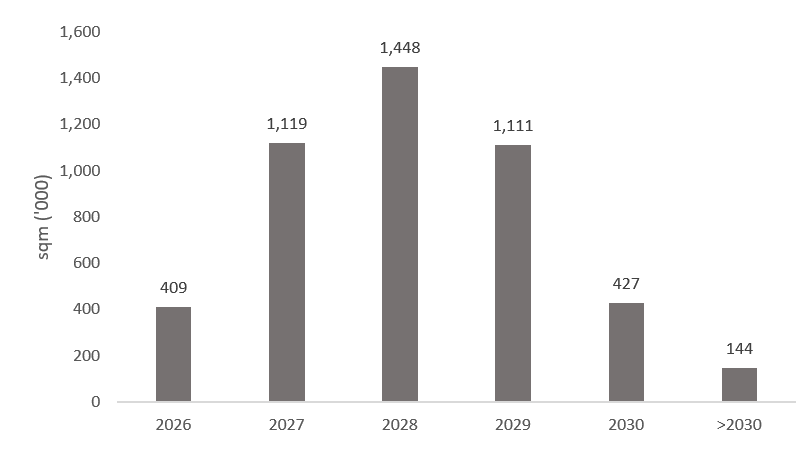
In the second quarter of 2026, 17 industrial projects totaling 480,170 sqm were completed. Highlights include a single-user factory at 2 Tampines Industrial Avenue 1 (233,220 sqm) and AST Building at 9 Pesawat Drive (70,890 sqm). Visionpower Semiconductor developed the Tampines facility, and Advanced Substrate Technologies built the Pesawat Drive factory. Both are semiconductor companies establishing facilities in Singapore, likely driven by increased semiconductor demand due to the AI boom.
Looking into the second half of 2026, 16 new industrial projects are expected to be finished, adding 263,840 sqm of industrial space to the market. Key developments include a warehouse at Tembusu Crescent (62,500 sqm) and a single-user industrial facility at Jalan Samulun (31,810 sqm).
The new completions should bolster occupier demand for industrial spaces, particularly as rental rates and occupancy levels continue to rise.
Chart 9: Upcoming Supply by Development Status and Expected Year of Completion
In conclusion
Singapore’s industrial property sector stayed resilient in the second quarter of 2026, driven by steady occupier demand and a surprisingly strong macroeconomic environment. The economy grew by 5.9% year-on-year in 2Q 2026, supported by healthy manufacturing sectors and high demand related to AI.
MTI reports that the manufacturing sector expanded by 12.5% year-over-year in 2Q 2026, surpassing the 7.3% growth seen in the previous quarter. This growth mainly stemmed from the electronics and precision engineering clusters, both of which benefited from strong AI-related demand. As a result, this rise is likely to support ongoing demand for industrial space, particularly in areas close to amenities.
Looking ahead, Singapore’s growth prospects for the second half of 2026 have strengthened, buoyed by increased global AI-related investment. Its status as a dependable trade and logistics hub, along with ongoing demand for modern, high-quality industrial spaces, is likely to sustain occupier interest in the latter half of 2026. Overall, industrial prices, rents, and occupancy rates are projected to stay robust, supported by the optimistic growth outlook.